63%
of organizations are targeting cloud variants of SAP S/4HANA
91%
of organizations want independent strategic oversight for their S/4HANA transformation
55%
of organizations position AI as core to their S/4HANA vision
Patterns in AI maturity and S/4HANA implementation readiness
Just as their migration experiences vary, participating companies exhibit a wide spectrum of AI adoption maturity levels, ranging from early exploration to mature enterprise-wide implementations. The data suggests a potential correlation between S/4HANA journey progress and AI organizational maturity. What’s evident is AI isn’t treated as peripheral to most S/4HANA programs, with the majority of organizations positioning it as central to their transformation vision.
AI adoption among surveyed organizations distributes across four maturity stages (see figure 1). Thirty-six percent characterize themselves as in "early learning and exploration," while 28.5 percent report having a "mature enterprise AI CoE" (center of excellence). In between those two ends of the spectrum, 21 percent indicated they have "some pockets of advanced usage" in their enterprise and 14.5 percent report "small, focused adoption."
Figure 1: Current AI adoption levels

Does AI play a part in companies’ migrations? Our survey says it does (see figure 2). When asked to characterize AI's role in their S/4HANA programs, a majority (55 percent) position AI as "core to our vision," indicating these organizations view AI as fundamental to their transformation objectives rather than ancillary. Another 40.5 percent describe AI as a "supporting enabler," while only 4.5 percent indicate AI is "not currently relevant" to their programs.
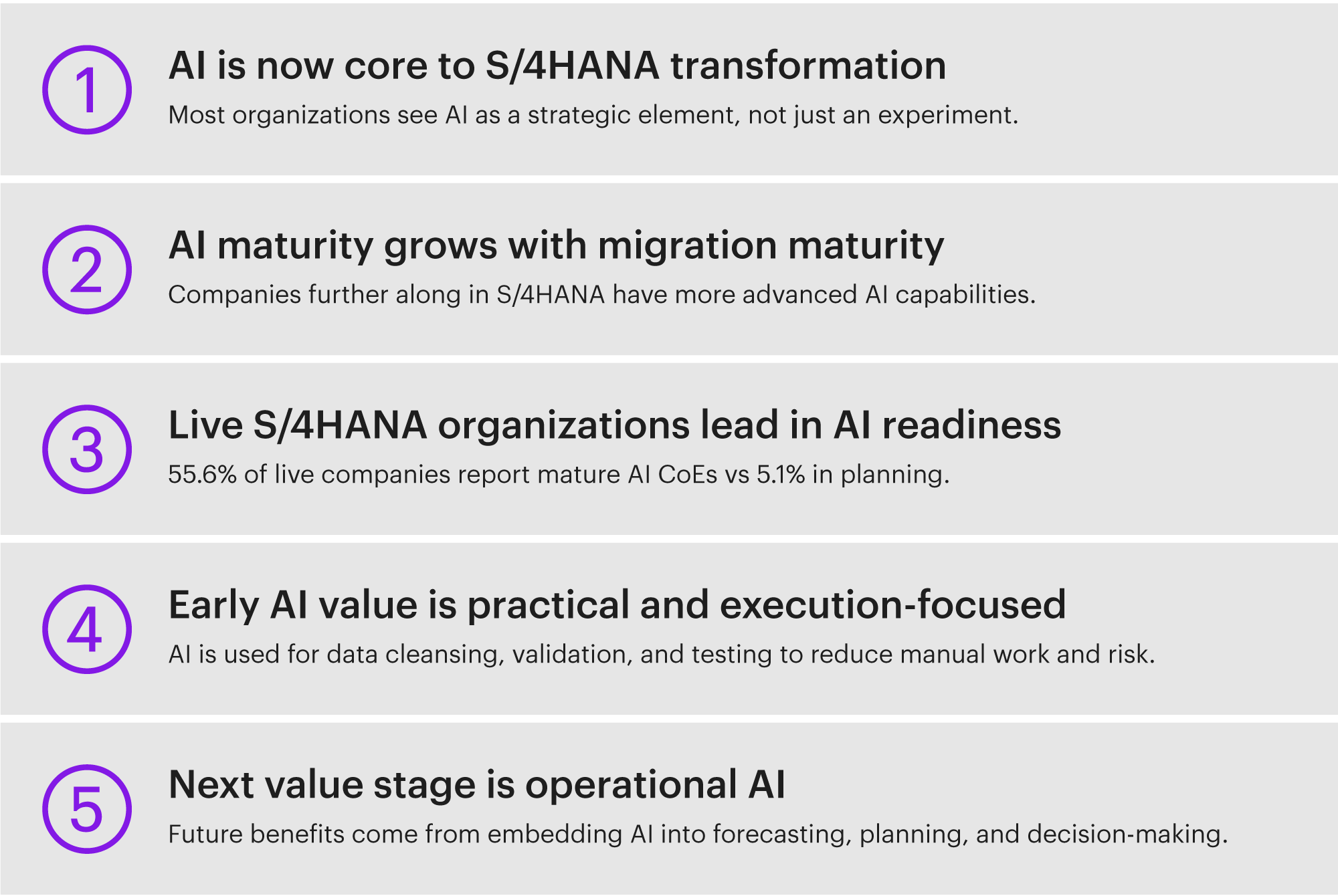
Organizations already live on S/4HANA show notably higher AI maturity: 55.6 percent report mature enterprise CoEs compared to just 5.1 percent among those still in the planning stage.
Where AI is delivering value today, and where it is going next
While AI is increasingly central to S/4HANA transformation, current adoption patterns show most organizations remain focused on practical, execution-oriented use cases. Early efforts are concentrated in areas such as data cleansing and migration, validation, testing, and intelligent process automation, aimed at reducing manual effort, improving data quality, and de-risking core program activities.
Figure 3: The most common use cases or intended use cases for AI in SAP
This reflects a broader trend. Organizations are prioritizing use cases that support implementation and stabilization, where value is immediate and measurable. In this phase, AI primarily enables efficiency and risk reduction rather than differentiated performance.
However, there are early signs of a shift. Growing investment in forecasting, predictive analytics, and AI-driven recommendations points toward more embedded, decision-oriented capabilities that extend beyond implementation and begin to shape how the business operates.
The gap between these use cases highlights the next challenge. While many organizations have adopted AI, fewer have integrated it into core workflows where it can drive sustained value. Bridging this gap will require a more coordinated approach that connects AI directly to business processes and decision-making.
As organizations progress in their S/4HANA journey, the ability to move from execution-focused AI to operational, decision-centric AI will be a key driver of long-term value realization.
Key findings from the research