


Most organizations aren’t as fast as they think
Speed is a priority in almost every boardroom. But there’s often a significant gap between an organization’s ambition to move quickly and its ability to execute. Traditional hierarchies, lengthy decision cycles, operational silos, and fragmented information can prevent businesses from responding when opportunities emerge.
The High-Velocity Organization challenges leaders to rethink how their enterprises operate. Drawing on research and examples from global companies, the book examines what separates organizations that merely aspire to move faster from those that consistently translate speed into business results.
What determines organizational velocity?
Moving faster requires more than accelerating individual processes. An organization may recognize an opportunity early but take too long to make a decision. Or it may reach a decision quickly but struggle to translate it into action.
The Velocity Value Equation, introduced in The High-Velocity Organization, captures this challenge. It identifies three interdependent capabilities that together determine an organization’s ability to turn speed into business performance.
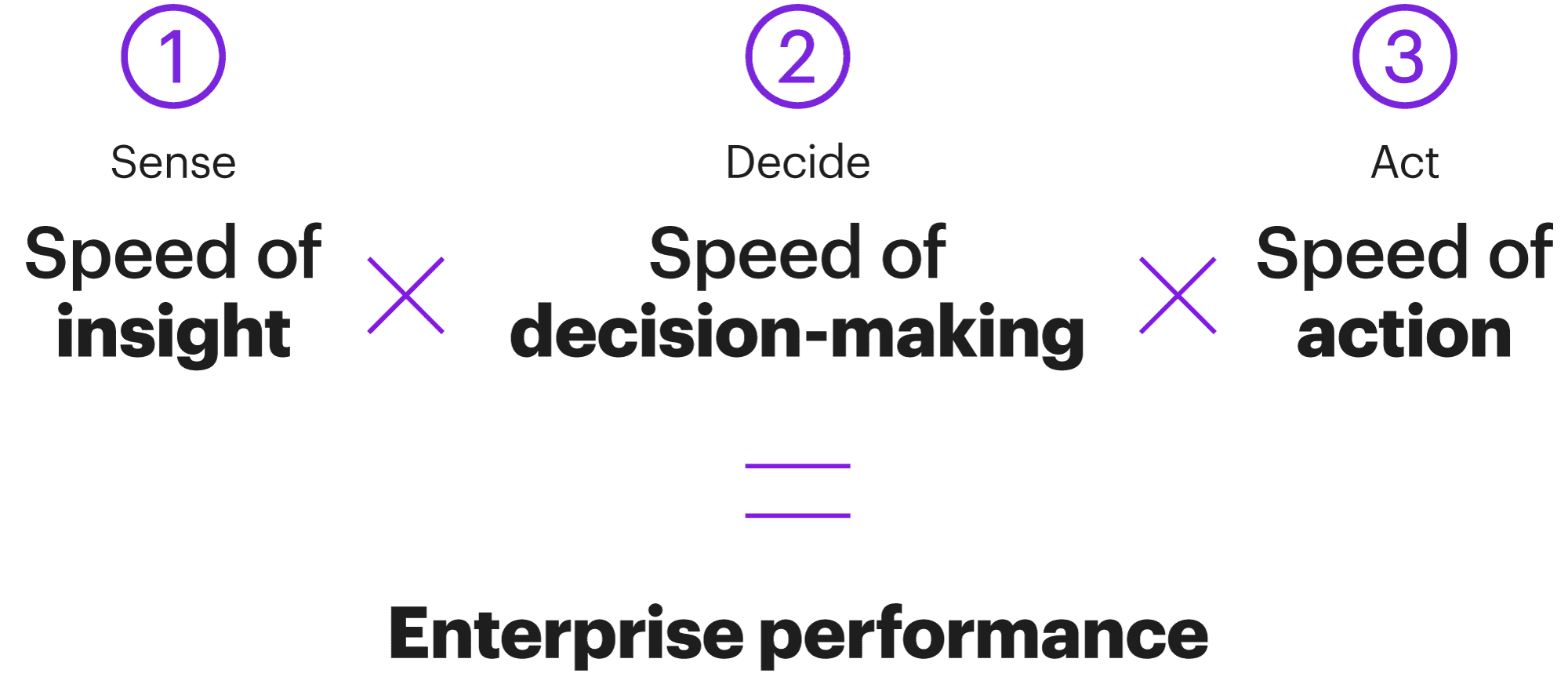
 Speed of insight |
|
 Speed of decision-making |
|
 Speed of action |
The relationship is multiplicative: strengthening one capability alone is not enough. Sustained performance depends on how effectively all three work together.
Building the capabilities of a high-velocity organization
Understanding what drives velocity is only the starting point. The challenge for leaders is building the structures, capabilities, and ways of working that make speed sustainable across the enterprise.
The book offers a practical approach to operationalizing intelligent speed across the enterprise. Readers will explore how to accomplish the following:
- Build enterprise sensing capabilities to detect emerging opportunities and disruptions.
- Design organizations that adapt more readily to changing conditions.
- Empower teams with clearer decision rights and greater autonomy.
- Use intelligent automation to accelerate execution at scale.
- Measure the outcomes that matter and identify where speed creates value.
- Lead the organizational transformation required to sustain velocity.
About the author

Suketu Gandhi
Partner and Chair, Operations and Performance
Chicago
Suketu Gandhi is a partner and chair of Kearney’s Operations and Performance practice. His expertise spans digital transformation, technology strategy, and end-to-end supply chain operations, with extensive experience working across the consumer, retail, and industrial sectors. He is also a co-creator of Kearney’s Supply Chain Institute, which advances research and thought leadership on the future of supply chains.
Suketu is the co-author of Strong Supply Chains Through Resilient Operations: 5 Principles for Leaders to Win in a Volatile World. His perspectives have appeared in leading business publications, including Harvard Business Review, MIT Sloan Management Review, and The Wall Street Journal.