


The materials transition trilemma
Global demand for materials is expected to increase 65 percent by 2050, driven by population growth, rising living standards, and the energy transition. Attempting to meet those needs with today’s linear materials value chains will lead to unacceptable levels of waste, harmful emissions, and pollution.
Facing pressure from customers, regulators, and other stakeholders, companies are striving to create carbon-neutral products that are also circular and regenerative in design. They now face a materials transition “trilemma”: how to reconcile profitable growth with sustainability aims, while ensuring the resilience essential to meet customer needs today and over the long term.
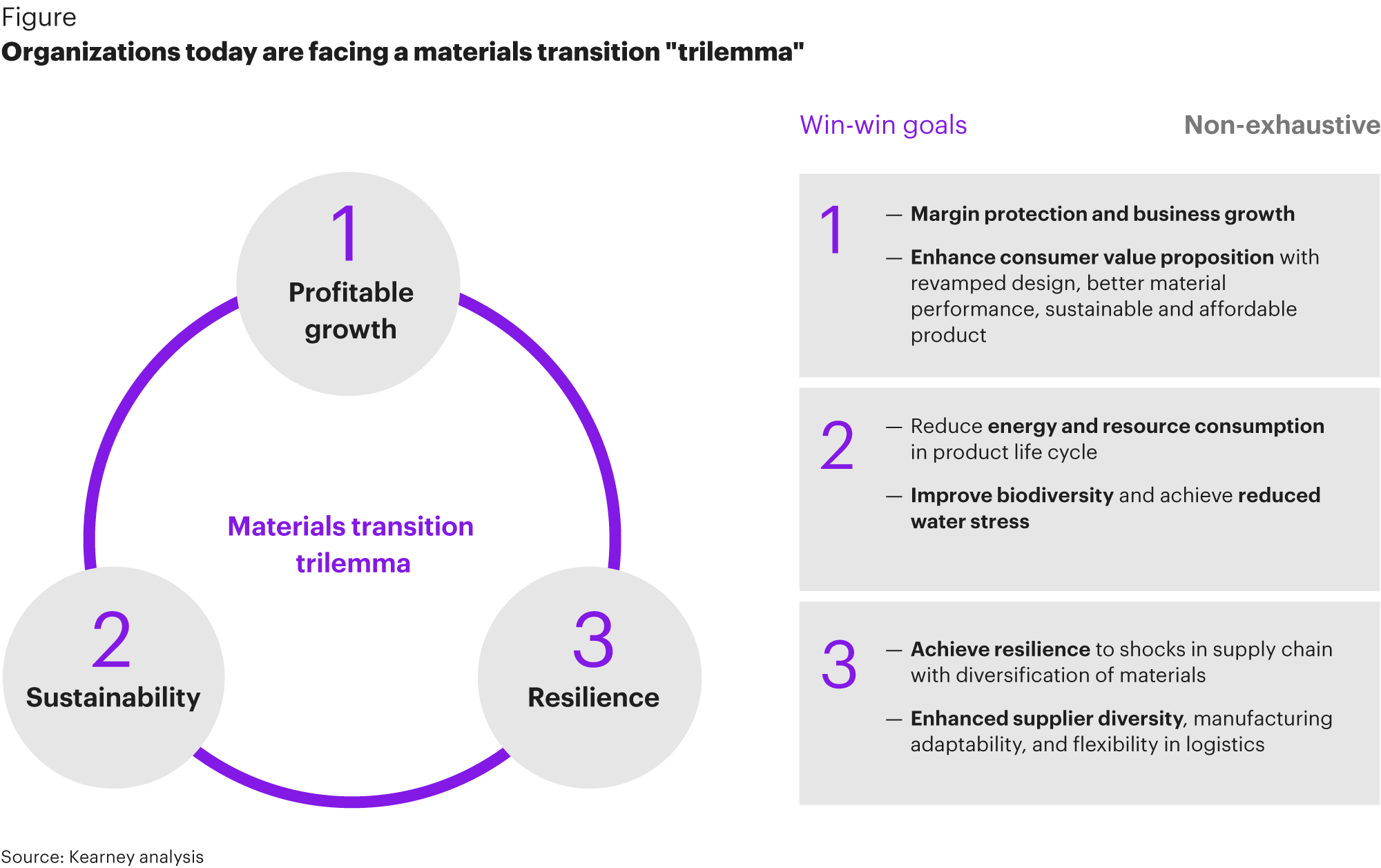

For companies that get the sustainable materials transition right, the benefits are compelling: margin protection and business growth, an enhanced consumer value proposition, increased supply chain resilience, and greater supply diversity. And they can achieve all that while maximizing energy and resource efficiency and minimizing waste, emissions, and water stress.
Companies are already embarking on the sustainable materials journey, by gradually adopting novel materials and capitalizing on the added advantages related to cost and functionality. Automotive players are adopting bio-based plastics derived from renewable sources such as corn and sugarcane, for example. In construction, laminated timber and bamboo offer alternatives to steel and concrete, while wool, cotton, and cellulose can replace petroleum-based insulation products.
Many sectors are also switching from virgin feedstocks to recycled materials. That’s a key element of the shift from a linear to a circular economy, which aims to preserve the value embedded in products and materials through reuse, refurbishment, remanufacturing, and recycling.
These are important steps, but companies will need to move further and go faster to meet their sustainability goals. That won’t be easy. Increased demand for sustainable and recycled feedstocks is already putting supply chains under strain, for example.
To maximize the sustainable materials opportunity, companies will need to move from pilots to scale by pursuing multiple approaches in parallel.
At the product level, that will include designs that use materials more efficiently, enable repair or reconditioning, and simplify disassembly. At the company level, it will include supply chains and business models that reduce waste and maximize material recovery and reuse. And at the systems level, it will involve collaboration with other stakeholders to develop and commercialize new material technologies for new supply chains or build better infrastructure for reuse and recycling.
The Kearney Sustainable Materials Institute brings together our expertise, experience, and data from across Kearney to support companies throughout their end-to-end sustainable materials journey. Clients will benefit from Kearney’s rich proprietary analytic tools and can draw upon the knowledge of more than 700 supply chain and procurement experts, 200+ design for sustainability experts, and benefits from insights and best practices derived from the analysis of more than 10,000 products.
Our key focus areas at KSMI include the following:
|
Material insights and fact-based perspectives
Provides reliable answers to help shape materials strategy, targets, and road maps, including supply-chain considerations. |
|
Sustainable suppliers and materials database
Provides access to a global network and proprietary resources, including start-ups. |
|
Design for sustainability
(DfS) helps companies unlock sustainability throughout the value chain through product (re)design and design to value (DtV). |
|
Sourcing and end-to-end operations
Provides strategic advice on defining and implementing operational interventions for scaling up and end-to-end value chain transformation. |
|
Alliances and partnerships
Provides specialized and innovative capabilities to help clients achieve materials transition impact. |
With the Kearney Sustainable Materials Institute, the path to sustainable materials can create value, without costing the earth.
To find out more please reach out to the KSMI team.